
How to Hire Employees in Another Country Without Setting Up a Company
Hiring globally sounds exciting… until you reach the part where someone asks:
“Do we have a legal entity in that country?”
And suddenly what felt like a simple hire becomes a whole new project:
- legal registrations
- payroll compliance
- taxes and benefits
- local labor rules
- contracts and policies
The truth is: you don’t need to set up a company in every country just to hire one great person.
In 2026, there are faster and smarter ways to hire internationally—without burning time, money, or effort.
This guide will walk you through:
✅ the easiest options to hire abroad
✅ what’s legal (and what can backfire)
✅ how much it costs
✅ how Employer of Record (EOR) simplifies global hiring
✅ why companies use ezyHire across 130+ countries
Quick Definition: Hiring Without an Entity (What It Means)
Hiring without an entity means employing someone in another country without registering your business locally.
You can do this using solutions like an Employer of Record (EOR), which legally employs the worker on your behalf while you manage their work.
Why Hiring Internationally Gets Complicated Fast
When you hire someone in your own country, the basics are clear:
- your company employs them
- payroll happens locally
- benefits follow local rules
- employment contracts use familiar formats
But when you hire across borders, every country works differently.
Common challenges include:
✅ Payroll compliance
Different tax structures, deductions, and payment requirements.
✅ Employment contracts
Contracts must match local labor laws—notice periods, termination clauses, benefits, etc.
✅ Statutory benefits
Some benefits are mandatory, and skipping them creates risk.
✅ Misclassification issues
If someone works like an employee but you treat them as a contractor, the risk increases.
✅ Entity setup delays
Opening a company abroad is a long process and often overkill for early hiring.
That’s exactly why “hire without entity” has become a high-intent search term.
4 Ways to Hire Employees in Another Country (Without Setting Up a Company)
Let’s break down the realistic options companies use today:
Option 1: Hire as an Independent Contractor (Fast but Risky)
This is the quickest route. You pay them as a freelancer/contractor.
✅ Pros:
- fastest to start
- low paperwork
- flexible engagement
❌ Cons:
- classification risk if they work full-time
- benefits aren’t covered
- long-term retention becomes harder
- can create legal/tax exposure
💡 Best for:
Short projects, part-time roles, temporary work.
Option 2: Use an Employer of Record (EOR) (Best for Full-Time Employees)
An Employer of Record solves the “no entity” problem cleanly.
With EOR:
✅ the EOR is the legal employer in the employee’s country
✅ your employee gets compliant payroll + benefits
✅ you manage day-to-day work like normal
💡 Best for:
Full-time hires, long-term roles, critical team members.
This is the most scalable approach for global hiring today.
Option 3: Use a Professional Employer Organization (PEO) (Only Works in Certain Cases)
PEOs typically co-employ or support HR processes—but in many countries, PEO models still require you to have an entity.
✅ Pros:
- strong HR support
- structured processes
❌ Cons:
- may not solve the “no entity” requirement
- may be limited by country
💡 Best for:
Companies that already have a legal presence in the country.
Option 4: Set Up Your Own Entity (Best for Large-Scale Expansion)
This is the classic route: register your business in another country and hire directly.
✅ Pros:
- full operational control
- long-term stable structure
❌ Cons:
- slow (weeks/months)
- expensive (legal, accounting, compliance)
- not ideal when you just want to start hiring now
💡 Best for:
If you’re hiring 10+ people in one country and expanding seriously.
The Best Way to Hire Abroad Without an Entity (For Most Teams)
If you’re hiring 1–20 employees globally, the best option is usually:
✅ Employer of Record (EOR)
It’s faster than building your own setup, and far safer than contractor misclassification.
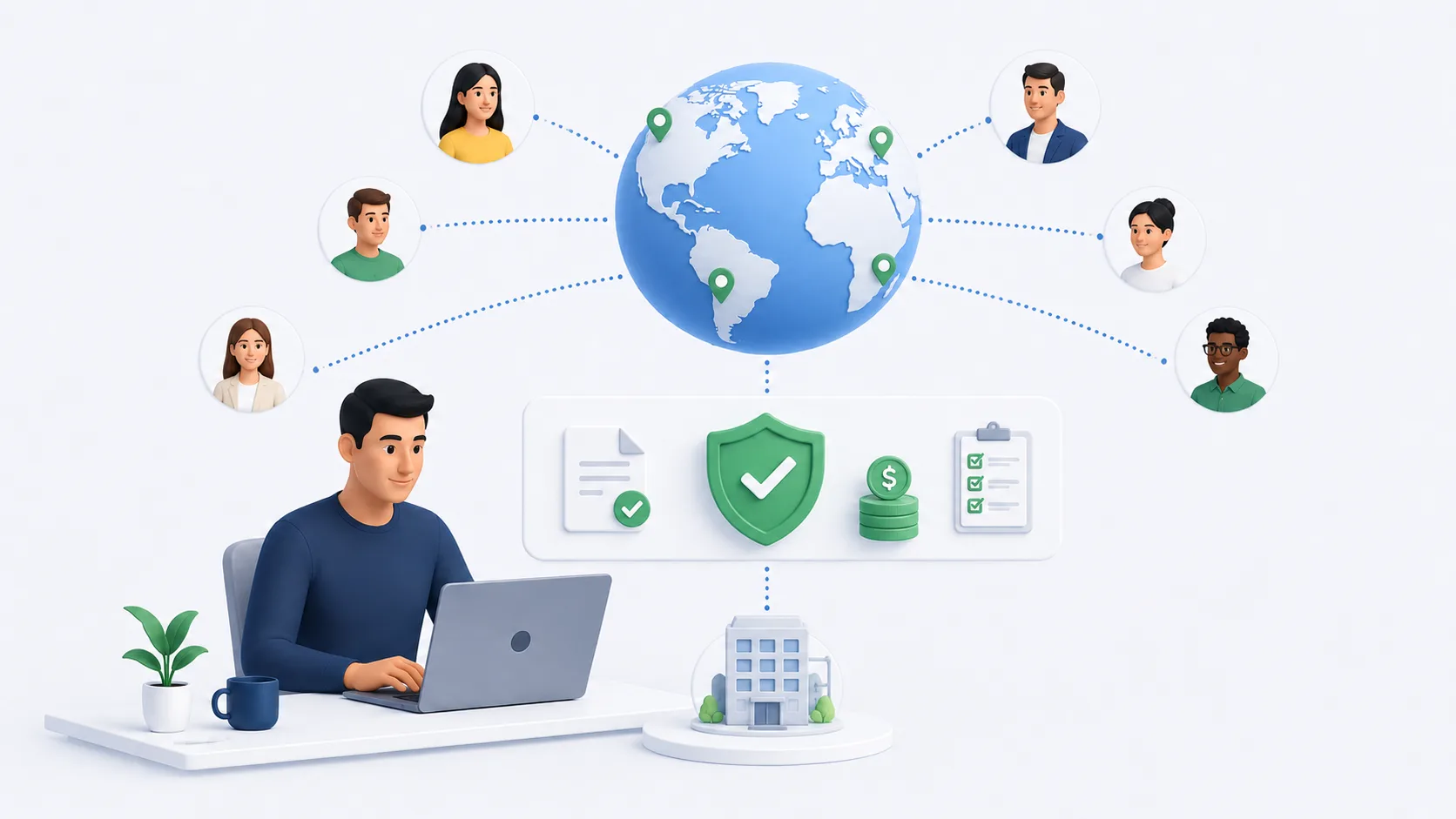
How EOR Helps You Hire Without Setting Up a Company
Here’s how the EOR model works:
✅ You hire the candidate
You interview, select, and decide compensation.
✅ EOR becomes the legal employer
The employee is employed legally in their country under the EOR.
✅ EOR handles:
- contracts
- payroll
- taxes
- benefits
- leave compliance
- onboarding paperwork
✅ You manage performance and work
Your team remains in full control of deliverables and roles.
This way, you expand globally without building local legal infrastructure.
Step-by-Step: Hiring International Employees Through an EOR
Let’s break down the EOR hiring journey in the simplest steps:
Step 1: Choose the role + location
Example: “Sales hire in UAE” or “Engineer in India”
Step 2: Confirm salary structure
EOR helps ensure salary and benefits align with local regulations.
Step 3: Contract is drafted + signed
Employment agreement is created as per local labor law.
Step 4: Employee onboarding begins
Documentation, payroll setup, benefits enrollment.
Step 5: Employee starts working with your team
They operate like a normal hire.
Step 6: Monthly payroll runs smoothly
Salary, taxes, deductions, payslips, compliance—handled.
✅ Smooth for you
✅ Secure for the employee
✅ Compliant for the business
Compliance You Must Know Before Hiring Abroad
Even if you “just want to hire one person,” compliance still matters.
Here are common compliance areas that differ country-to-country:
✅ Leave policies
Annual leave, sick leave, parental leave.
✅ Benefits
Insurance, statutory contributions, mandatory allowances.
✅ Termination clauses
Notice periods, severance, documentation.
✅ Payroll timelines
Some countries follow strict pay schedules.
This is why using an EOR reduces risk: they build compliance into the hiring setup automatically.
What Does It Cost to Hire Internationally Without an Entity?
Costs depend on the option you choose:
Contractor model
- lowest upfront cost
- but hidden risk cost can be high
EOR model
Typical pricing:
✅ $200–$800 per employee per month
This usually includes:
- contract management
- payroll + taxes
- HR compliance support
- benefits administration (as per local rules)
Entity setup model
- high setup cost
- ongoing legal + accounting expenses
- slower time-to-hire
💡 For most companies, EOR is the best “time + cost + risk” balance.
H2: Why Businesses Choose ezyHire to Hire Without an Entity
Global hiring should feel simple—not like a legal case study.
That’s why ezyHire’s EOR services are built to make hiring “effortless”:
✅ hire employees in 130+ countries
✅ payroll, taxes, benefits, and compliance handled
✅ onboarding support so employees start smoothly
✅ leave + insurance coverage support
✅ cost-effective alternative to setting up entities
Your outcome:
✅ faster hiring
✅ lower risk
✅ less HR operational overload
✅ global scale without headaches
CTA Block (Primary)
Ready to Hire Globally Without Setting Up an Entity?
With ezyHire’s Employer of Record (EOR) services, you can hire international employees legally—without opening a local company.
We handle:
✅ contracts
✅ payroll + taxes
✅ benefits + insurance
✅ compliance + onboarding
👉 Get Started with ezyHire EOR Services
Internal Link: https://ezyhire.com/eor-services/
FAQs — Hiring International Employees Without an Entity
1) Can I hire someone in another country without setting up a company there?
Yes. You can hire using an Employer of Record (EOR), which legally employs the person on your behalf.
2) What is the easiest way to hire employees internationally?
For full-time roles, EOR is usually the easiest and safest route. For short-term work, contractors can work (with caution).
3) Is hiring contractors the same as hiring employees?
No. Contractors are self-employed. Employees have different legal protections, benefits, and compliance requirements.
4) What happens if I misclassify a contractor as an employee?
Misclassification can lead to penalties, back taxes, and compliance issues depending on the country.
5) How long does it take to hire someone using an EOR?
Often within days to a couple of weeks depending on documentation and country requirements.
6) How much does an EOR cost?
Typically between $200–$800 per employee per month, depending on country and benefits.
7) Do I manage the employee if they are hired through an EOR?
Yes. You manage their work, reporting, and day-to-day tasks. The EOR handles the legal and payroll side.
8) Can I switch to an entity later?
Yes. Many companies start with EOR and move employees to their own entity once they scale.
Hiring internationally doesn’t need to be complicated.
If you want to expand globally without entity setup, payroll confusion, or compliance stress—
✅ ezyHire makes it effortless.