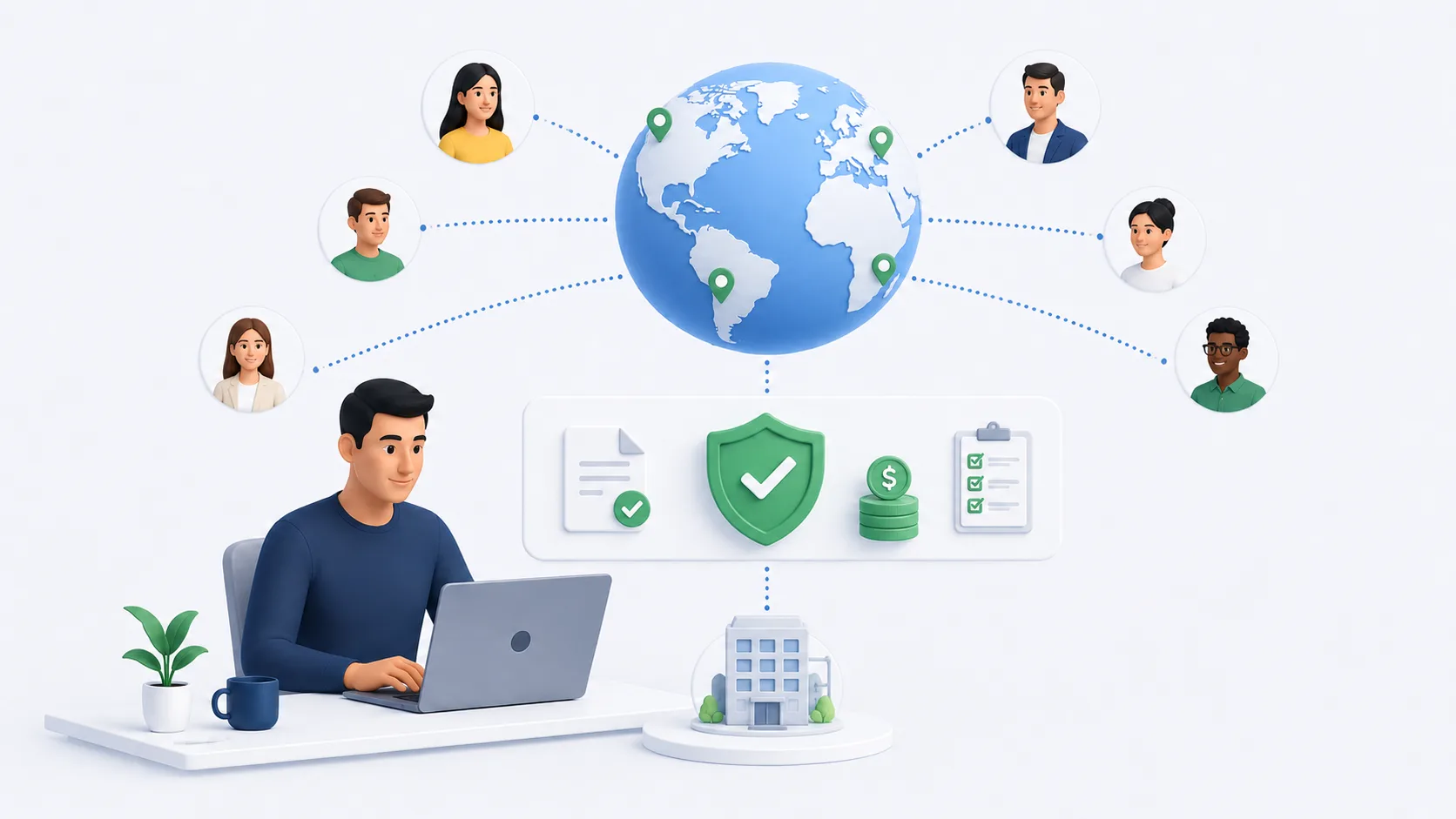

The US is one of the most competitive talent markets in the world.
If you’re hiring in the USA, you’re probably doing it for one of these reasons:
- you want to build a sales or customer success team close to your market
- you need US-based leadership or expansion hires
- you want access to top-tier tech, product, and growth talent
- you’re expanding operations into North America
But there’s one major blocker that slows most companies down:
“How do we legally hire employees in the US if we don’t have a US entity?”
That’s exactly why the biggest search term you’ll see from founders and HR teams is:
✅ EOR vs entity setup in USA
Because if you choose the wrong option early, you lose time, money, and sometimes the candidate too.
This guide covers:
✅ US hiring basics
✅ EOR vs entity setup (speed + cost + complexity)
✅ step-by-step hiring workflows
✅ compliance + payroll factors
✅ pricing expectations
✅ the easiest way to hire in the USA in 2026
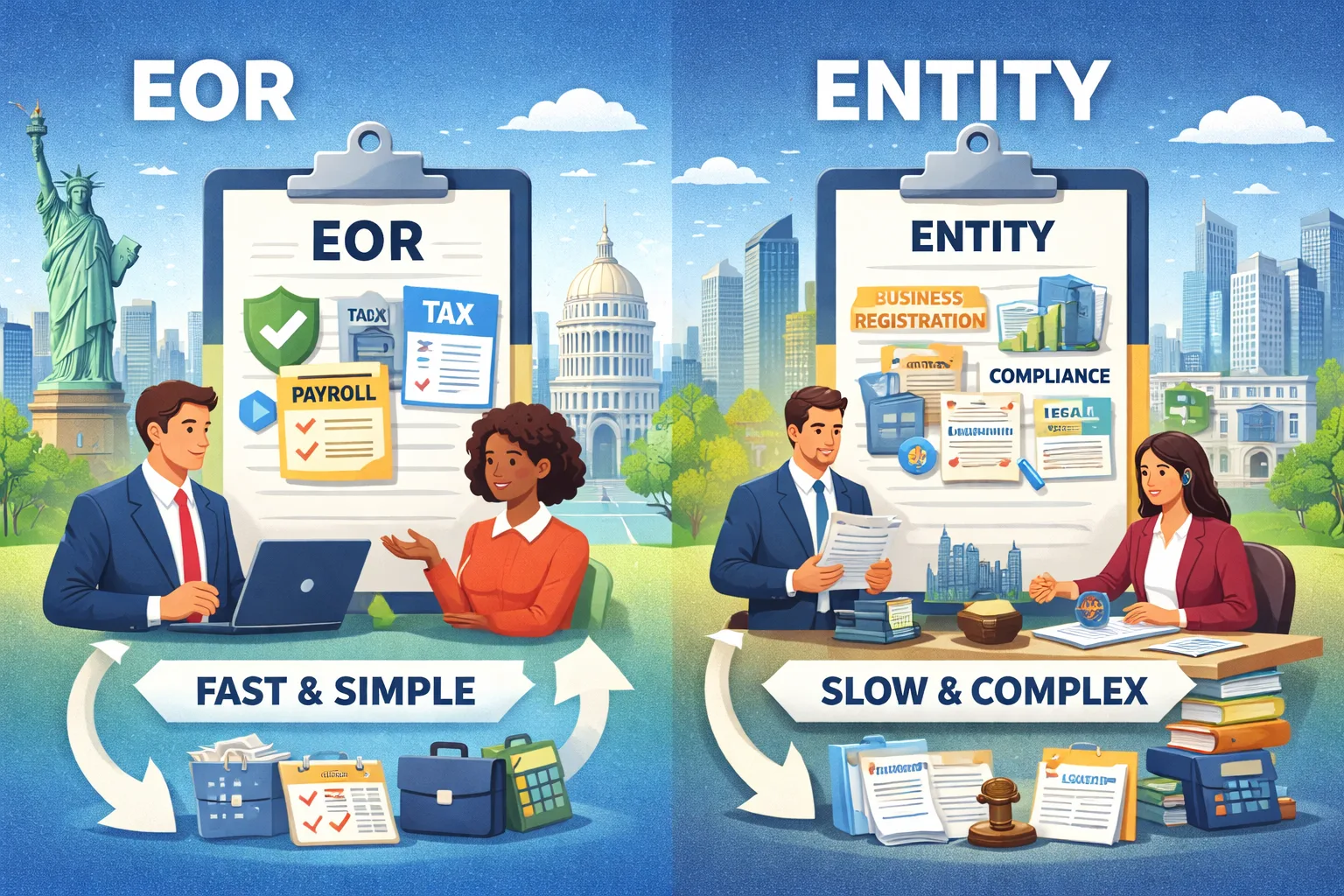
Quick Definition: EOR vs Entity Setup (USA)
- EOR (Employer of Record): A third party legally employs your US employee on your behalf and handles payroll, taxes, benefits, and compliance.
- Entity setup: You register your own company in the US and become the direct employer, managing payroll, benefits, and compliance yourself (or via vendors).
Why Hiring in the USA Feels “Harder Than Expected”
Hiring in the US is attractive—but it’s also operationally intense.
Unlike hiring informally or contractor-first, US employment typically requires:
- clean offer letters + contracts
- payroll compliance workflows
- employee tax processing
- structured benefits expectations
- HR policies + documentation
- multi-state considerations (depending on where the employee lives)
So when a company says “we want to hire one person in the US,” what they really need is:
✅ a compliant way to employ them
✅ a predictable payroll structure
✅ a benefits framework
✅ a fast onboarding process
Option 1 — Setting Up a US Entity (What It Involves)
Entity setup means you register your company in the US (directly or via legal partners). Once done, you become the direct employer and you manage everything.
✅ Pros of US entity setup
- full control of employment relationship
- direct employer branding and employment structure
- long-term scalable if you’re hiring a lot
❌ Cons of US entity setup
- slower timeline to get “hire-ready”
- legal and accounting overhead
- ongoing filings and maintenance
- payroll and benefits setup still required
Best for:
Companies that are:
✅ building a large US team (10+ hires)
✅ planning long-term US operations
✅ ready for legal/accounting overhead
Option 2 — Hiring Through an EOR in the USA (Fastest Route)
An EOR is built for speed and compliance.
Instead of opening a company in the US, you can:
✅ hire the employee
✅ onboard quickly
✅ stay compliant from Day 1
✅ avoid building internal US HR/payroll infrastructure
✅ Pros of using EOR in USA
- no US entity required
- faster onboarding
- payroll + compliance handled
- benefits support (structured and smoother employee experience)
- ideal for 1–20 hires
❌ Cons of EOR in USA
- monthly per-employee cost (service fee)
- not always the final stage (some companies transition later)
Best for:
Companies that:
✅ want to hire quickly
✅ are testing US expansion
✅ don’t want legal/admin setup delays
✅ need a compliant employment model fast
EOR vs Entity Setup in USA — What’s Faster?
Let’s answer the real question.
✅ Entity setup speed
Entity setup timelines vary, but typically:
- it takes weeks to be fully operational
- you still need to set up payroll and benefits systems
So even after the entity exists, your hiring setup may not be “ready.”
✅ EOR speed
With an EOR, you can often onboard much faster since:
- the employment infrastructure is already ready
- compliance processes already exist
- payroll is already configured
✅ In most cases, EOR is faster for hiring in USA when you don’t already have an entity.
Step-by-Step: Hiring in the USA Using an EOR
Here’s the workflow when hiring via EOR:
Step 1: You select the employee
You finalize the candidate, role, start date, and reporting.
Step 2: You decide compensation
Salary in the US often includes:
- base salary
- variable/commission (for sales roles)
- bonuses (optional)
Your EOR provider can help ensure the structure is employment-ready.
Step 3: EOR drafts compliant employment documentation
This includes:
- offer letter / contract structure
- onboarding documents
- employment policies aligned to the hiring state
Step 4: EOR onboards the employee
Onboarding may include:
- payroll setup
- benefits enrollment (if included)
- employment forms + documentation workflow
Step 5: Employee starts working with your team
Day-to-day work is managed by you:
✅ tasks
✅ deliverables
✅ performance reviews
✅ culture + team rituals
Step 6: EOR runs payroll + compliance
The EOR handles:
- salary payments
- payroll deductions
- payslips/documentation
- compliance support
Step-by-Step: Hiring in the USA Through Your Own Entity
If you go the entity route, your path typically looks like this:
Step 1: Register your company in the US
Time varies depending on structure and support partners.
Step 2: Set up payroll infrastructure
You may need:
- payroll provider
- compliance workflows
- accounting + reporting readiness
Step 3: Define benefits and HR policies
US employees often expect benefits to be structured and clearly communicated.
Step 4: Hire + onboard employee
You run onboarding directly or through HR vendors.
✅ This gives full control, but it takes more setup effort.
Compliance + Payroll Considerations for US Hiring
The US market is high-opportunity, but here are the operational factors to plan for:
✅ Multi-state employment complexity
Employees in different states may have different employment requirements.
✅ Payroll compliance and documentation
Payroll must be accurate, timely, and well-documented.
✅ Benefits expectations
US employees often expect benefits to be clear and competitive—especially for full-time roles.
💡 This is why EOR helps: it brings structure and compliance without forcing you to build an in-house system immediately.
How Much Does It Cost to Hire in the USA via EOR?
EOR pricing typically ranges:
✅ $200–$800 per employee per month
Cost depends on:
- employee location (state-specific factors may apply)
- benefits scope
- complexity of payroll structure
- headcount volume
The advantage is:
✅ predictable monthly cost
✅ faster hiring
✅ reduced internal admin burden
Common Hiring Mistakes in the USA (And How to Avoid Them)
Here are mistakes that slow companies down:
❌ Mistake 1: Waiting too long to choose EOR vs entity
If you’re hiring one person, EOR is often the fastest decision.
❌ Mistake 2: Starting with contractors for full-time roles
If the role is full-time and ongoing, contractor models can create classification risk.
❌ Mistake 3: Ignoring employee experience
US hires expect clean onboarding, clear documentation, and reliable payroll.
❌ Mistake 4: Underestimating compliance and payroll admin
Even one US hire creates operational requirements.
When Should You Choose EOR vs Entity Setup in USA?
Here’s a simple decision rule:
Choose an EOR if:
✅ you need speed
✅ you’re hiring 1–20 employees
✅ you’re testing US expansion
✅ you don’t want entity + payroll setup overhead
✅ you want compliance handled end-to-end
Choose entity setup if:
✅ you’re building a large US workforce
✅ you need deep operational control
✅ you’re ready for long-term legal + accounting investment
Why Companies Choose ezyHire for US Hiring (EOR)
If you want the easiest way to hire in the US without slowing down your growth—
ezyHire’s Employer of Record (EOR) services are designed to make hiring seamless.
With ezyHire, you get:
✅ compliant employment support
✅ payroll + taxes handled
✅ employee benefits + insurance support
✅ onboarding support
✅ leave + HR compliance management
✅ coverage across 130+ countries (ideal if your hiring is global, not just US)
✅ transparent pricing + tailored solutions
Hiring in the USA? Start Fast with ezyHire EOR
Skip the delays of entity setup and start hiring in the US confidently.
With ezyHire’s EOR services, we handle:
✅ contracts + onboarding
✅ payroll + compliance
✅ benefits + HR support
👉 Get Started with ezyHire EOR Services
FAQs — Hiring in USA (EOR vs Entity)
1) Can I hire in the USA without a US entity?
Yes. You can hire in the US through an Employer of Record (EOR).
2) What’s faster: EOR or entity setup in the US?
In most cases, EOR is faster because the compliance and payroll infrastructure already exists.
3) Is EOR legal in the US?
Yes. EOR is a legal and widely used model for compliant hiring.
4) How much does an EOR cost in the USA?
Typical EOR pricing ranges from $200–$800 per employee per month, depending on benefits and complexity.
5) Does an EOR handle US payroll?
Yes. EOR providers manage payroll processing, documentation, and compliance workflows.
6) Do I manage the employee’s daily work if I use an EOR?
Yes. You manage all work, performance, reporting, and responsibilities.
7) Can I switch from EOR to my own entity later?
Yes. Many companies start with EOR and transition later after scaling.
8) Should startups use EOR for US hiring?
Yes—especially if you’re hiring quickly and don’t want the overhead of entity + payroll setup.Hiring in the US can unlock massive growth—but only if you do it compliantly and quickly.
If you want the fastest path to onboard US talent without entity setup:
✅ ezyHire’s EOR services make it effortless.